





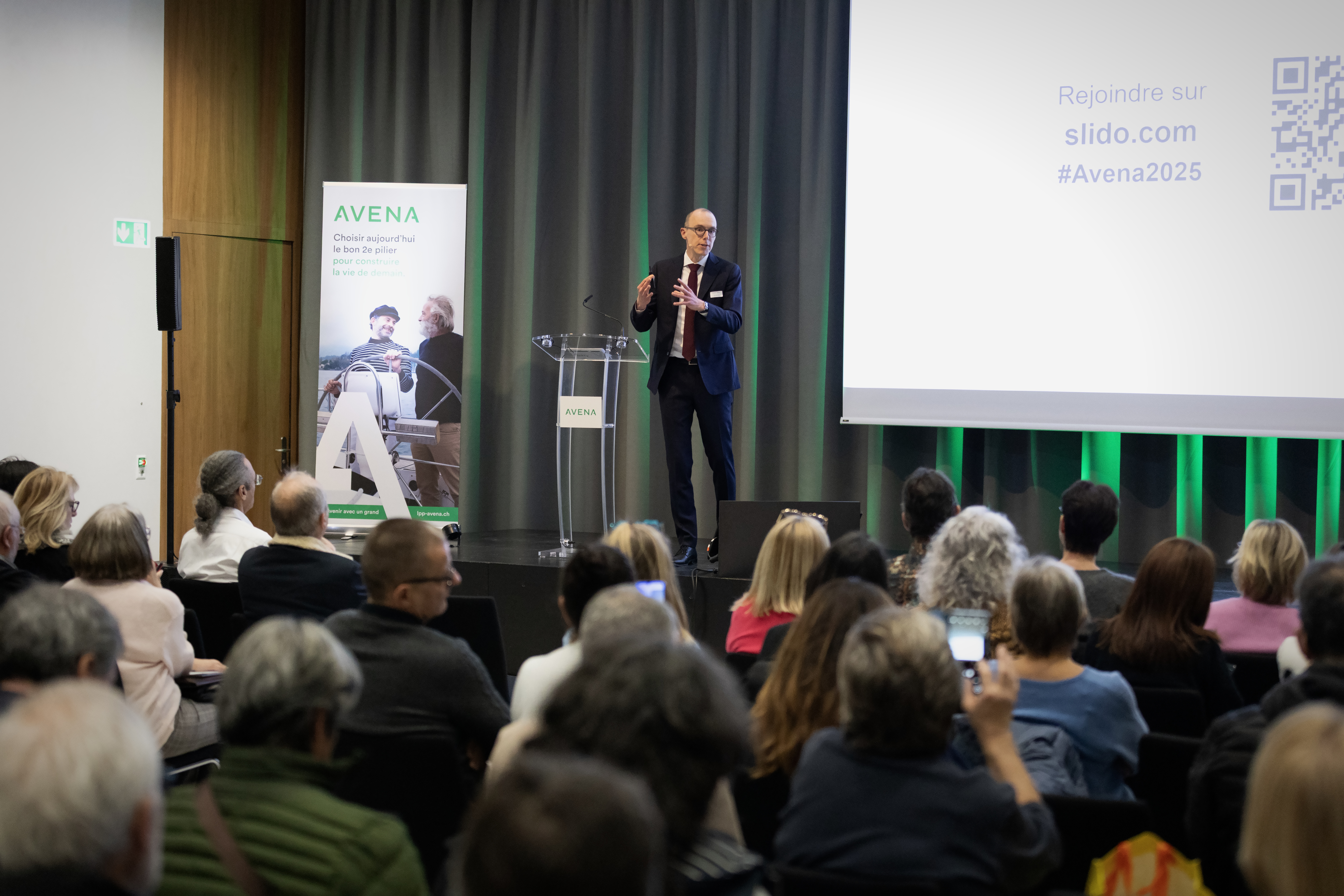
Should I take a regular pension or a lump sum? Retire at 58 or at 65? What is a voluntary contribution and how do I make one? In November 2025, AVENA published an explainer video and held two evening information sessions to help fund members better understand their occupational pensions and plan for retirement. As always, the online and in-person participants had numerous questions for the experts.
Citing a recent study by the Lucerne University of Applied Sciences and Arts, Valère Gogniat, who moderated AVENA’s two evening information sessions last year, noted that only 1 in 100 survey respondents could correctly answer 10 questions about the Swiss pension system. Translation: most people don’t really understand how their pensions work, and all questions are valid. Our pension experts took the stage at these events to explain the more technical aspects of Swiss pensions and answer basic questions such as: How does a pension fund work? What’s the difference between net salary and pensionable salary? What is a coordination deduction? How do I know how much I have in retirement savings? What is retirement capital?
The two sessions, “The ABCs of your occupational pension” and “Key steps in retirement planning,” were held in various formats (online, in person, and video recording) and gave fund members an opportunity to ask their questions and get answers from our specialists on the spot.
The most common question at the sessions was whether to opt for a pension or a lump-sum payment at retirement. AVENA pension board member Christian Caperos reassured attendees that, as is often the case with pension-related matters, there’s no one right answer: rather, it’s a personal choice that depends on each member’s situation. He then summed up the advantages and disadvantages of each approach (available here in French, on slides 9 and 10). Tax implications are a key consideration: pensions are counted as income and are therefore fully taxable, while lump-sum payments are taxed as assets. Francis Bouvier, the director of AVENA, listed a number of other important factors to consider: the member’s health, which plays a crucial role; their family; their lifestyle; their ability to manage a large sum of money and stick to a budget; and tax considerations. The speakers pointed out that members could also choose to combine a partial lump-sum payment with a smaller pension amount, although such solutions should always be worked out individually with a pension advisor.
Tackling the issue of voluntary contributions
Numerous members submitted questions both online and in person about voluntary contributions – those extra contributions you can make to your pension fund to make up for shortfalls in your pension savings. These shortfalls are common today because careers are less linear than they used to be due to interruptions (such as gap years, parental leave, or periods of unemployment) and work-time decreases. Voluntary contributions have a number of important advantages, as Mr. Caperos reminded attendees: they increase a member’s pension savings and insured benefits, they’re tax-deductible, and they accrue interest at the rate set each year by the pension board. What’s more, AVENA – unlike some other pension funds – returns all voluntary contributions in full to the member’s beneficiaries if the member dies.
However, there are also some restrictions on voluntary contributions. For example, although such contributions can be made at any time before retirement, those made in the three years preceding retirement can’t be paid out as a lump sum. For that reason, members who want to receive their pension savings as a lump sum should finish making their voluntary contributions three years before their planned retirement date. Members also can’t use funds they previously paid into their Pillar 3a accounts (individual retirement accounts) to make voluntary contributions to their occupational pension fund, since those funds were already declared as a tax deduction.
Mr. Caperos also shared a new development with fund members: starting in 2026, Swiss residents will be permitted to make voluntary contributions to their Pillar 3a accounts, i.e., to make up for years in which they did not pay in the maximum tax-deductible amount. The time frame concerned will eventually be extended to the previous ten years; however, in 2026 it will only cover 2025, meaning that the immediate effect of the measure is fairly limited.
The importance of the third pillar
What if you’ve already made the maximum permitted voluntary contribution to your occupational pension? Mr. Caperos suggested that members speak with their employer about switching to a higher-level pension plan or increasing their salary. He also notes that they could consider paying into an individual retirement account (i.e., Pillar 3a account).
Fund members had numerous questions about the third pillar of the Swiss pension system, such as: How many Pillar 3a accounts can you have in total, with banks or insurance companies? BCV pension specialist Olivier Reymond, a featured speaker at the evening session held at the Musée Cantonale des Beaux Arts, explained that it all depends: two is the limit in some cantons, while in Vaud you can open three, four, or even five Pillar 3a accounts. In addition, your own tax history and relationship with the cantonal authority can play a role.
Separately, fund members at the live chat in particular asked a number of pension-related questions concerning cross-border workers and those planning to leave Switzerland after retirement.
Key milestone years to keep in mind
The AVENA speakers also took this opportunity to remind fund members of important pension milestone years that they may be unaware of. For example, you must have turned 58 to receive your first pension payment. Members who stop working before 58 will also stop contributing to their pension plan, and their pension savings will be transferred to a vested benefits account. If this happens, the member may need to save more in order to have the desired level of income in retirement. The speakers also reminded attendees that they could open a Pillar 3a account at any time before they turn 70, as long as they’re receiving income from gainful employment and paying AVS contributions.
In order to best prepare for retirement in view of these milestone years, the speakers shared some helpful tips with fund members: from age 40, they should check their death and disability coverage and pay into one or more Pillar 3a accounts; members who have made a pension withdrawal to purchase a home should repay the funds within 10 to 15 years. From age 50, they should begin planning their retirement, make the maximum voluntary contribution permitted by their pension fund, and decide whether to remain in their home after retiring. From age 60, they should be ready to retire at any time, since – for health or economic reasons – the choice isn’t always up to them.
Want to learn more? Check out our 30-minute video, The ABCs of your occupational pension. In it, Mr. Reymond and Nicolas Colozier, an AVENA actuary, cover the topics discussed here in greater detail, as well as recent developments and challenges for the Swiss pension system that will affect everyone who works in Switzerland.
Learn more
Click on the links below for a recap of the three information sessions discussed here.
- The ABCs of your occupational pension – an explainer video that summarizes key information about second pillar pensions
- Slides for our Key steps in retirement planning evening session (in French)
- Video of our Live chat – Occupational pension Q&A evening